Stop 7 of 8Must-see
Antonio Sant'Elia and the Città Nuova
Where to stand
On the top floor, in the rooms devoted to Antonio Sant'Elia, facing the drawings of buildings and stations
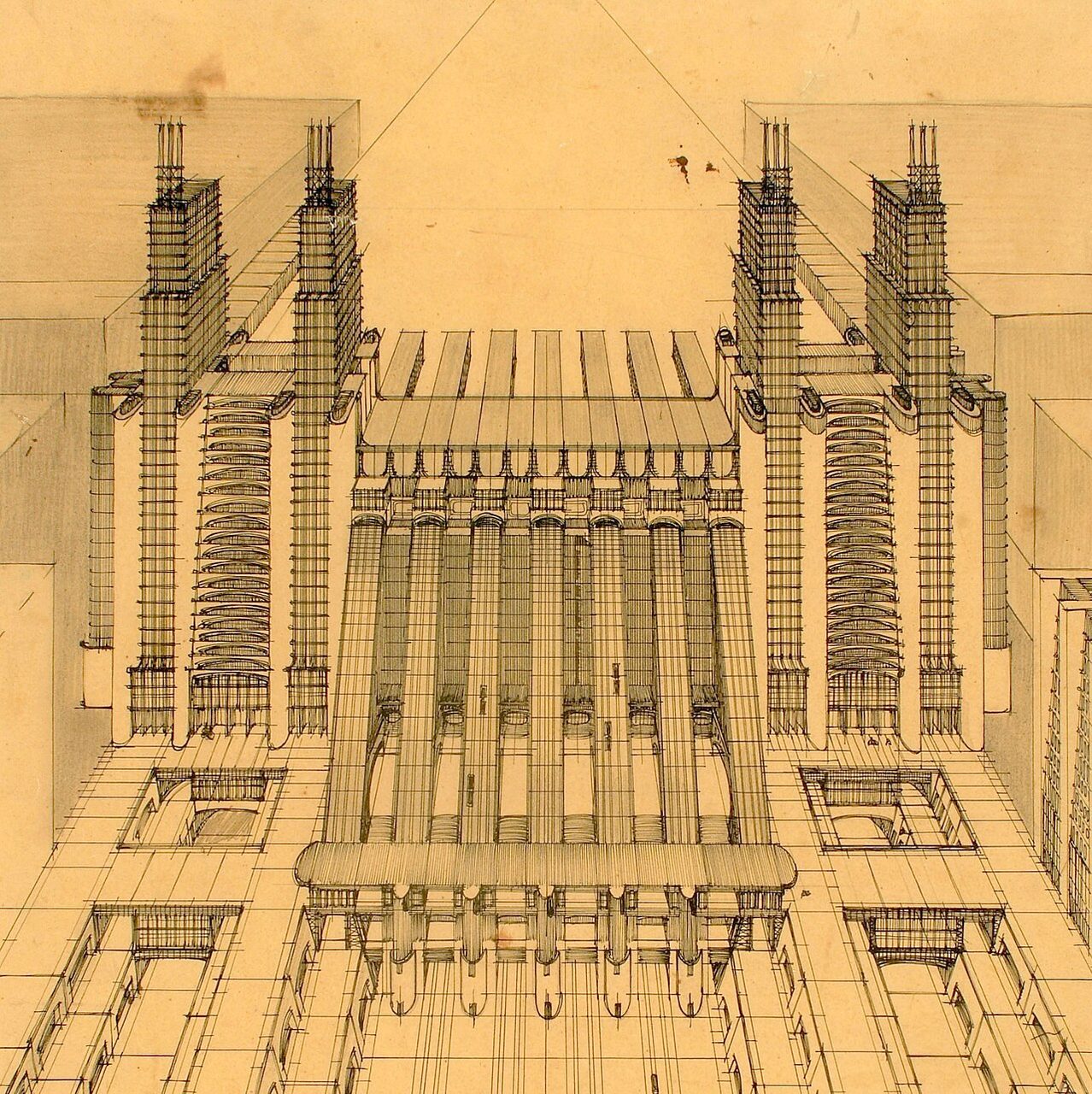
A Como man killed in the war at twenty-eight, who built almost nothing and drew the city of the future. Stations for trains and airplanes, multilevel streets, elevators everywhere: sheets in pencil and ink that bring to mind a lot of the science-fiction cinema that came later.
Spot the detail
Among the sheets of the Città Nuova look for the station: how many different ways of getting around can you count?
The full story
Move in close, because they are small. Some of these sheets are barely bigger than a postcard, yet they hold entire cities.
Antonio Sant'Elia was born in Como, the son of a hairdresser. He earned a master builder's diploma, worked as a draftsman in Milan and attended the Accademia di Brera, Milan's fine arts academy, for a while without finishing.
He had a prodigious hand and one fixed idea: the modern city should not look like the old one. It should be a machine, made for movement.
The drawings of the Città Nuova
In 1914, at twenty-six, he exhibited in Milan the drawings of the Città Nuova, the New City. Look at them one by one.
- Stations where trains and airplanes cross paths.
- Streets on several levels, with passages reserved for pedestrians.
- Elevators everywhere.
- Power stations as monumental as cathedrals.
A few weeks later the Manifesto of Architecture came out under his name. It is the text that brings Futurism into architecture.
The war and the drawings
Then came the war. Sant'Elia volunteered and died in October 1916 near Monfalcone, hit while leading an assault. He was twenty-eight.
Of built work he left very little: a villa in Brunate, above Como, and not much else. Of drawn work, a great deal. His archive is kept by this museum and numbers more than one hundred and seventy sheets.
From paper to the movies
And it is on paper that he won. The towers and suspended streets of Metropolis, the film shot in the 1920s by the director Fritz Lang, are often compared to these drawings. Half a century later, the same is said of the gloomy city of Blade Runner. Many cities of the future you have seen at the movies resemble those of a young man from Como who never saw even his own built.
One of his ideas, here in town, did turn to stone. The Monumento ai Caduti, the war memorial on the lakefront, grew out of a sketch Sant'Elia made before the war: a lighthouse tower. In the 1930s that drawing was transformed into a war memorial and built under the direction of the Terragni brothers. If you walk past it, remember these sheets.
About this stop
In culture
From Sant'Elia's Città Nuova to Blade Runner
On its top floor the Pinacoteca keeps the drawings of Antonio Sant'Elia, the architect born in Como who in 1914 imagined a Città Nuova, a New City. They never became a city, but they have a lot to do with the movies. The towers and suspended streets of Metropolis, the film shot in the 1920s by the director Fritz Lang, are often compared to these drawings. The same is said, more than fifty years later, of the gloomy Los Angeles of Ridley Scott's Blade Runner. Look at those pencil sheets and you find a world of images you already know, even if you have never heard their author's name.
Anecdote
Buried in the Cemetery He Had Designed
On the top floor the Pinacoteca keeps the drawings of Antonio Sant'Elia, the architect born in Como. His last project was not a city of the future. In 1916 he was an infantry second lieutenant on the Carso, the plateau behind Trieste, and his commander gave him an architect's job: the brigade's war cemetery at Monfalcone. On October 10, during an assault, he was killed by a machine-gun bullet. They buried him there, in the cemetery he had designed. Five years later his remains were brought to Como. The man who imagined stations for airplanes left as his last work his own first grave.
Anecdote
The Lighthouse Tower That Became a Memorial
Como's Monumento ai Caduti, the war memorial on the lakefront, was not designed for the fallen. It grew out of a pencil, pastel and watercolor sketch by Antonio Sant'Elia, the Como architect whose drawings are on the Pinacoteca's top floor. He made it before the war: a lighthouse tower. In 1930 Filippo Tommaso Marinetti, the founder of Futurism, proposed building that drawing instead of the design already in hand. The painter Enrico Prampolini turned it into architecture and the brothers Attilio and Giuseppe Terragni built it. It opened in 1933: Sant'Elia, killed in the war in 1916, got his only large building, one of the fallen among the fallen.
Very little. For certain a villa in Brunate, above Como, built around 1912, and a few tombs. He died in the war at twenty-eight, in 1916, before he could build even one of the structures of his Città Nuova. His fame rests entirely on the drawings, and the archive kept by the Pinacoteca numbers more than one hundred and seventy. The largest building tied to his name is posthumous: Como's Monumento ai Caduti, the war memorial, derived in the 1930s from one of his sketches.
Next stop
Continue on the same floor toward the rooms of the Como abstract painters and Giuseppe Terragni