Stop 1 of 5Must-see
The striped facade
Where to stand
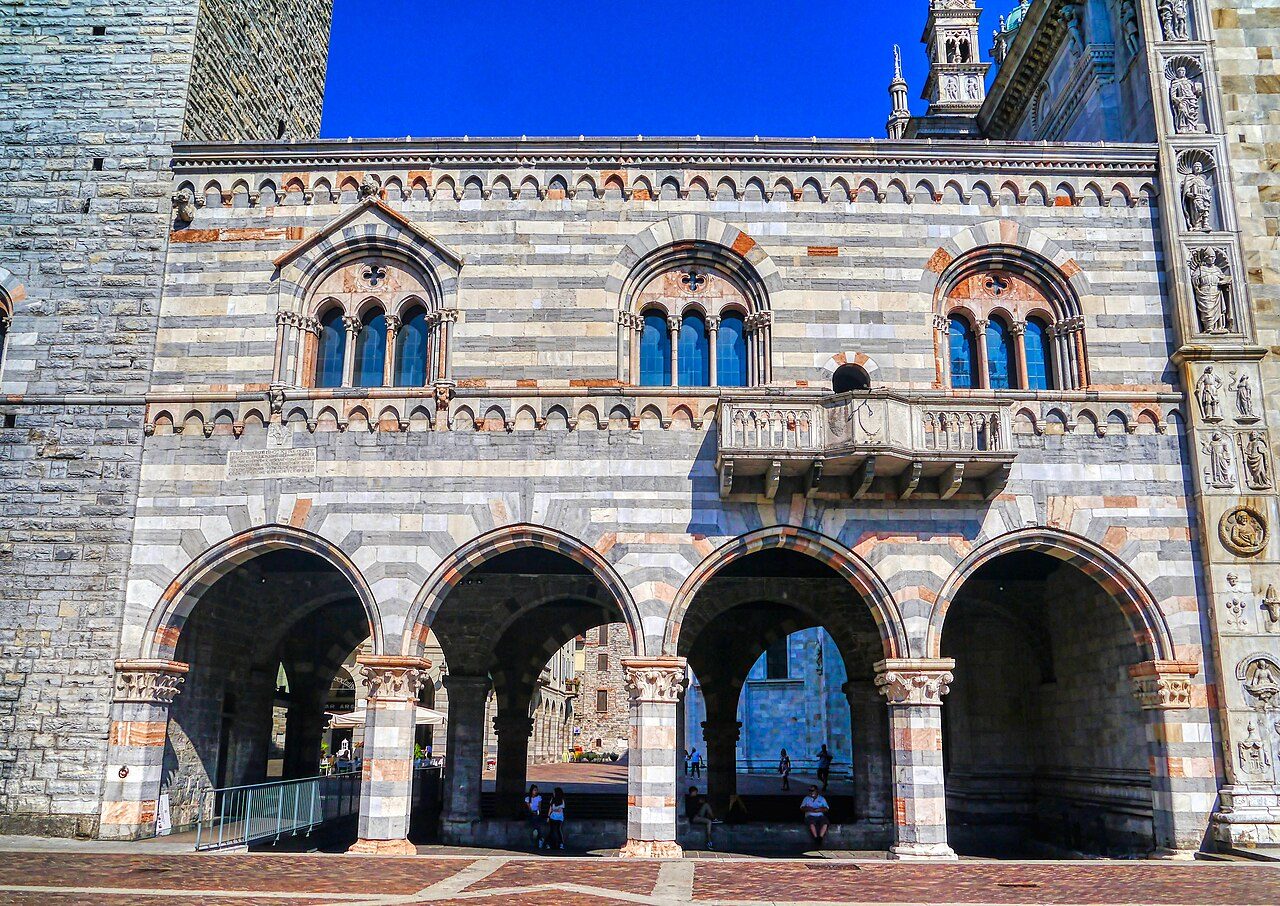
In Piazza del Duomo, facing the palace with colored bands that stands to the left of the cathedral
Como's medieval city hall: a portico below, a great hall above and three colors of stone laid in bands. A plaque dates it to 1215, but the arches and windows tell a slightly longer story.
Spot the detail
The stripes look white and gray. Find the third color
The full story
Look at the palace to the left of the Duomo, Como's cathedral: it looks like a striped box. White, gray and red bands, one on top of the other, from the portico up to the roof. This is the , the city hall of medieval Como, and those stripes were its way of getting noticed next to the cathedral.
Portico below, hall above
The layout is that of the town halls of Lombardy. Below, an open portico with four big, barely pointed arches on sturdy piers: a space that belonged to everyone, where people passed through and gathered. Above, a single great hall, lit by three , each divided in three by slender colonnettes. On the left the tower closes the row, all bare stone, without a single stripe.
The name and the date
The name tells you where all this comes from. is the diminutive of brolo, a walled plot of land. There was a meadow here where citizens were already gathering in assembly in the 11th century, a stone's throw from the old cathedral.
In the early 13th century the Comune, the self-governing city, bought the land from the Church and built its own house on it. Under the left-hand window a plaque gives the date, 1215, and the name of the man who wanted the palace: Bonardo da Codazzo, , the magistrate who governed the city at the time.
Do not take the plaque too literally. The frame is Romanesque, massive, but the pointed arches and the are already Gothic in taste. Scholars think the work went on for a long time, or that the palace was rebuilt after that date. More alterations came in the 15th century.
The stones through Ruskin's eyes
The stones come from the lake. Laid in bands, they turn a simple building into a surface that shimmers. John Ruskin, the 19th-century English art critic, noticed: he drew one of the 's windows and had it reproduced among the plates of The Stones of Venice, his book on Venetian architecture. He also made a quick watercolor of it for the drawing school at Oxford, to show how marbles are inlaid.
Today the palace is shorter than it was when it was built, and for centuries it looked lower than it is. Those are two stories you will find at the next stops.
For now, hold on to the picture: a young, proud city government that chooses, for its own seat, the spot next to the most important church in town. And dresses in stripes.
About this stop
In culture
Up at five for the Broletto
George Edmund Street, the English architect who later designed the Royal Courts of Justice in London, reached Como one evening in the mid-19th century. An Austrian band was playing in Piazza del Duomo, and he stayed to look by moonlight at the colored marble front of the , the medieval city hall. His carriage was leaving at seven: soon after five in the morning he was in the square, sketching. In the book that followed he wrote that for beauty the Broletto was scarcely inferior to any building he had seen in Italy. And the Duomo, the cathedral next door? He went in reluctantly and found it large but uninteresting.
In culture
The Broletto window Ruskin liked
John Ruskin, the 19th-century English art critic, stopped in front of a window of the , Como's medieval city hall with its bands of colored stone, and drew it. The color plate that Thomas Shotter Boys made from it is the fifth in the first volume of The Stones of Venice, published in 1851. Ruskin also made a quick watercolor of it, to show how marbles are inlaid, and in 1875 he gave it to the drawing school at Oxford that bears his name. Today the sheet is at the Ashmolean Museum.
Because these are different stones, laid in horizontal bands: white, gray and red. The white is Musso marble, the same used later for the facade of the Duomo. The gray is Moltrasio limestone. These are materials from the quarries on the lake. The striped effect gives richness to a building with simple forms and sets it apart from the tower, which is all bare stone worked in .
Next stop
Stay where you are and look up to the second floor, toward the windows and the balcony